
DevSecOps teams shouldn’t have to choose between decent security and affordable pricing, or risk getting stuck with one vendor.
Most platforms either gate essential capabilities behind high-tier plans or require piecing together separate tools for SAST, SCA, containers, and runtime protection.
To cut through the noise, we reviewed 8 Snyk alternatives against five key factors: base-tier unified scanning (SAST, SCA, containers), active runtime detection, transparent pricing, cloud posture or infrastructure scanning, and smooth developer integration. The gap between marketing and actual accessibility is often surprisingly large.
Best Snyk Alternatives
These eight Snyk alternatives are evaluated on security coverage, runtime protection, pricing, and use cases. They range from all-in-one DevSecOps platforms to specialized tools for SAST, SCA, runtime defense, cloud security posture, and supply chain security.
Black Duck
Black Duck has been around since 2002 and offers the longest track record in application security. Teams tired of chasing false positives appreciate how its 20+ years of human-verified open source intelligence cuts the noise before it hits your backlog.
Unlike Snyk and newer tools that rely on heavy automation, Black Duck unifies SAST, SCA, and AI-powered analysis in one SaaS platform. This eliminates the usual tool sprawl where teams juggle multiple vendors.
It also supports both cloud and on-premises deployments. That flexibility is important for regulated industries and air-gapped environments, especially when competitors push cloud-only setups that don’t fit compliance needs.
Pros:
- Human-verified intelligence database reduces false positive rates significantly
- Unified SAST + SCA + AI analysis eliminates vendor juggling
- Deployment flexibility (cloud or on-prem) fits regulated environments
Cons:
- Resource-intensive for on-premises deployments
- Setup and integration can be complex, especially in large environments
- Scan performance may slow down on large codebases
- User interface and reporting capabilities feel dated compared to newer platforms
Why Choose This Platform?
Switch to Black Duck if your team loses more time triaging noisy scanner results than fixing real vulnerabilities. Decades of curated intelligence let it spot the CVEs that actually matter in your stack.
It’s a strong fit for enterprises with legacy codebases and modern microservices. The hybrid model and mature integrations offer the consistency that newer platforms struggle to match.
Aikido
Aikido is widely regarded as one of the best Snyk alternatives for organizations looking for broad security coverage without managing multiple products.
The platform combines SAST, DAST, SCA, Infrastructure as Code scanning, container security, Cloud Security Posture Management (CSPM), secret detection, API security, and runtime protection within a single interface.
Instead of piecing together multiple security products, Aikido unifies application, cloud, container, dependency, and runtime protection in one place. This reduces complexity for dev and security teams and gives them consistent visibility across the development lifecycle.
It emphasizes consolidated workflows, fewer noisy alerts, and straightforward adoption through developer-friendly tools and smart automation. Many organizations like it because it delivers broad capabilities—often locked behind premium plans elsewhere—along with transparent pricing.
Pros:
- Unified platform for code, cloud, container, and runtime security
- Fast deployment with low operational overhead
- Developer-friendly workflows that reduce alert fatigue
Cons:
- Different from traditional security tools
- Migration from legacy platforms may require adjustment
- Less focused on customized procurement processes
Why Choose This Platform?
If your team wants to consolidate security tools, Aikido is worth considering.
It brings container scanning, IaC security, secrets detection, cloud posture management, and application testing into one platform. This approach gives you good coverage without the usual complexity of juggling multiple vendors.
As a platform launched in 2022, it was designed specifically for modern cloud-native setups and DevSecOps workflows. Its combination of strong features, easy start-up, reduced false positives, and clear pricing makes it appealing for organizations that need to scale security efficiently.
Opengrep

Opengrep is an open-source SAST tool born as a community fork of Semgrep after its 2024 licensing changes. Backed by several security companies, it keeps code analysis transparent and compatible with Semgrep’s community rules and workflows.
The tool scans source code using customizable rules, helping teams find vulnerabilities, enforce secure coding, and spot risky patterns across many languages. Since it’s fully open source, you can inspect the detection logic and adapt it to your exact needs without proprietary black boxes.
Pros
- Open-source SAST platform with transparent detection logic
- Highly customizable rules and security policies
- Supports self-hosted deployments and CI/CD integration
Cons
- Focused primarily on SAST rather than full DevSecOps coverage
- No dedicated enterprise support tier currently available
- Runtime security, DAST, and cloud security require additional tools
Why Choose This Platform?
If transparency, flexibility, and open-source control are key for your security setup, consider Opengrep. It lets your teams create custom detection rules and enforce internal coding standards while clearly showing how vulnerabilities are detected.
The tool excels at catching framework-specific risks and custom patterns that commercial scanners often miss. It also supports local deployment and easy integration with your CI/CD pipelines, so you stay in control without vendor lock-in.
For organizations wanting a customizable open-source SAST solution, Opengrep offers a practical foundation that can grow alongside your needs.
Prisma

Palo Alto Networks’ Prisma Cloud is a CNAPP designed to protect cloud infrastructure, workloads, containers, and applications across their full lifecycle.
It goes beyond code-focused tools by offering broad visibility over AWS, Azure, Google Cloud, Kubernetes, and containers in one platform.
The solution brings together security posture management, workload protection, threat detection, vulnerability handling, compliance, and container security. This makes it easier to find issues, track runtime behavior, apply policies, and meet requirements in complex multi-cloud environments.
Pros
- Comprehensive cloud security coverage
- Strong multi-cloud and Kubernetes support
- Advanced compliance and governance capabilities
Cons
- Can be expensive for smaller teams
- Steeper learning curve
- Complex interface for large deployments
Why Choose This Platform?
Many organizations choose Prisma Cloud when they want security insight that reaches beyond application code and dependencies. The platform centralizes control over cloud infrastructure, workloads, containers, runtime environments, and compliance in a single view.
It’s especially useful for enterprises operating across AWS, Azure, and Google Cloud. Teams dealing with large or multi-cloud deployments like its extensive cloud-native security and solid governance tools.
FOSSA
FOSSA eliminates friction between developers and legal teams on open source compliance by automating policy enforcement across the entire SDLC. Reachability-based analysis reduces false positives and noise, showing only vulnerabilities in code paths that actually execute, not every theoretical dependency buried in your stack. This precision keeps security teams focused on real risks while developers ship faster.
The platform combines dependency scanning across the entire SDLC with automated policy enforcement, ensuring compliance gates trigger at the right moments without manual intervention. SBOM generation and container scanning are included, giving teams full supply chain visibility from source to production. No feature gatekeeping. No surprise upsells.
FOSSA bridges the gap between security rigor and development speed—teams get comprehensive open source risk management without the compliance theater that bogs down releases.
Pros:
- Reachability analysis cuts vulnerability noise by filtering out unexploitable paths
- Automated policy enforcement across SDLC eliminates manual compliance checks
- SBOM generation and container scanning included in the base platform
Cons:
- Focused more on compliance than application security
- Performance can be slower in larger environments
- Limited issue-level troubleshooting context
Why Choose This Platform?
Choose FOSSA when legal compliance and developer velocity are both non-negotiable. Traditional SCA tools bury teams in false positives from transitive dependencies that never execute—FOSSA’s reachability engine shows what actually matters. Automated policy enforcement means compliance gates work in the background, not as release blockers requiring manual approvals.
The platform excels for organizations managing large open source footprints where license risk and vulnerability management intersect. SBOM generation and container scanning eliminate the need for separate tooling, while dependency scanning across every SDLC stage catches issues before they reach production. Teams gain supply chain visibility without sacrificing speed.
Tenable
Tenable built an exposure management platform built for the AI era, moving well beyond basic point-in-time scans. While most DevSecOps tools simply dump lists of isolated vulnerabilities, Tenable pulls together security data from across your environment. It shows how those weaknesses can actually chain together into real breaches and maps the attack paths an adversary might take.
The platform gives you one unified view across IT, cloud, OT, and hybrid setups. That eliminates the blind spots that pop up when teams try to stitch together tools from multiple vendors.
Instead of chasing every CVE, Tenable helps you prioritize fixes based on actual exploitability and real risk. For enterprises running complex infrastructures—where a sloppy cloud bucket might connect straight to an unpatched OT controller—this kind of visibility is essential.
Pros:
- Cross-environment attack path visualization shows how isolated issues compound into critical exposure
- Unified platform eliminates vendor sprawl across IT, cloud, and operational technology
- Exposure-based prioritization cuts through vulnerability noise with exploitability context
Cons:
- Reporting customization may be limited
- Extensive features can require a learning curve
- Less focused on developer workflows than Snyk
Why Choose This Platform?
Tenable, Inc. excels when your security challenge extends beyond application code into infrastructure, cloud configurations, and operational technology.
Organizations running hybrid environments—where a vulnerability in legacy OT systems can cascade through cloud services into customer-facing applications—gain the most value from Tenable’s unified exposure view.
The platform’s ability to map how scattered weaknesses chain together into exploitable paths helps security leaders justify remediation investments with business-relevant risk context, not just CVSS scores.
Anchore
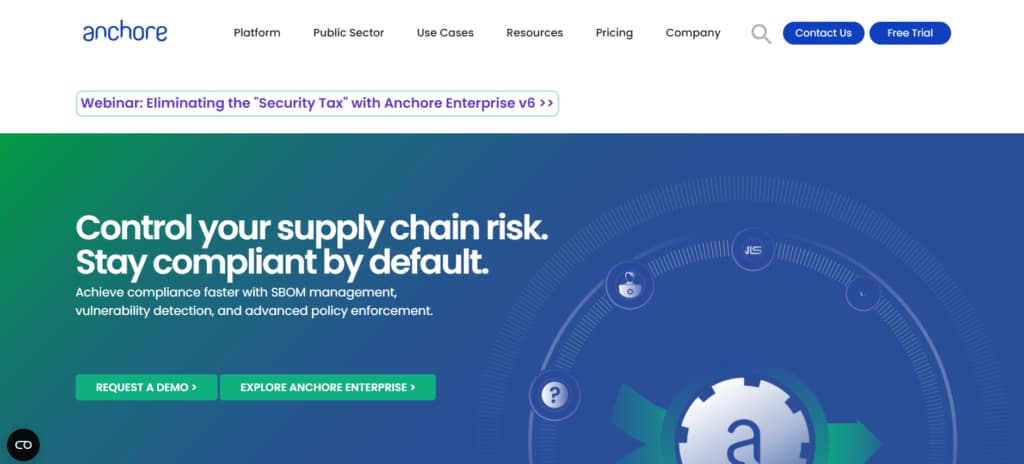
Founded in 2016, Anchore moved the conversation from basic vulnerability scanning to proper proactive SBOM management. The platform combines vulnerability checks, secret detection, malware analysis, and compliance automation into a single workflow, which helps eliminate the usual tool sprawl in DevSecOps setups.
For teams in regulated industries, the built-in FedRAMP, DISA, and NIST support for container scanning is a big deal. It’s there from day one.
While other tools often treat supply chain risks as separate add-ons, Anchore handles it all in one platform. It scans, finds secrets before they escape, catches malware in dependencies, and creates useful SBOMs that stand up to real scrutiny. Kubernetes and microservices teams get solid visibility without vendor lock-in.
Pros:
- SBOM generation and container scanning unified in one platform, not bolted together
- FedRAMP/DISA/NIST compliance automation eliminates manual policy translation
- Detects secrets and malware alongside CVEs—supply chain coverage without tool sprawl
Cons:
- Policy customization may require additional setup
- Deployment can be more complex than developer-focused tools
- Limited SAST and DAST capabilities compared to broader AppSec platforms
Why Choose This Platform?
If container security is critical for you and you’re fed up with stitching together tools for vulnerabilities, secrets detection, and compliance, Anchore makes a lot of sense. The platform’s SBOM-first design means you’re already building an audit trail from the beginning.
This is particularly helpful for Kubernetes environments. You get the compliance proof you need without hiring extra people to handle all the tooling. It rolls up what would normally take three vendors into one platform.
Oligo Security

Oligo Security is a runtime-focused platform that helps teams prioritize vulnerabilities based on what’s actually running in their applications, not just static scan results.
Instead of flagging every issue as critical, it looks at real production behavior. This way, teams can zero in on risks that are reachable and truly exploitable.
The platform brings together runtime SCA, SBOM generation, licensing checks, and exploitability analysis in one place. With this runtime context, security teams cut down on alert fatigue and focus their efforts on the vulnerabilities that matter most in live environments.
Pros
- Runtime-based vulnerability prioritization
- Focuses on exploitable and reachable risks
- Combines runtime SCA, SBOMs, and compliance visibility
Cons
- No automatic code fixes
- Not a full CSPM solution
- Limited incident response capabilities
- Minor runtime overhead possible
Why Choose This Platform?
Consider Oligo Security when your organization faces too many vulnerability alerts and limited remediation resources. Rather than chasing every finding from static analysis, it helps teams prioritize issues that are actively executed in live environments.
Conclusion
The right Snyk alternatives depend on your main pain points.
Aikido combines tools with transparent pricing. Oligo cuts false positives using runtime context. Black Duck provides human-verified intelligence for enterprises. Anchore unifies supply chain security with SBOMs. FOSSA balances compliance and developer speed. Tenable maps infrastructure-wide attack paths. Opengrep offers open-source SAST without vendor lock-in.
Run a quick proof of concept with one or two that fit your urgent needs. Test integration with your workflows before committing long-term.