
Bank integration complexity remains a major pain point — 63% of fintech CTOs list it as their primary infrastructure bottleneck. Still, choosing the right Open Banking provider frequently proves more challenging than the build itself.
A poor choice brings PSD2 compliance struggles, lengthy bank-by-bank integrations, and unclear pricing structures. A strong one, by contrast, can slash your time to market from several months to just weeks.
In this review, we compare five UK-authorised Open Banking providers. We focused on three key factors: how deep and well-documented their API coverage is, their regulatory licensing for AIS and PIS, and how quickly you can actually deploy them for growing SaaS platforms.
We favoured providers with clear integration timelines, transparent pricing, and proven operational history over those that rely mostly on marketing.
How to Evaluate Open Banking API Providers
When evaluating Open Banking API providers, weight these factors against your deployment timeline and technical architecture:
- Regulatory scope — AIS-only platforms can’t initiate payments; PIS licensing enables Pay by Bank. Some providers handle both data access and payment initiation through a single integration.
- Bank coverage depth — UK-only vs pan-European vs global. The largest networks connect 10,000+ institutions, but niche providers often deliver faster UK-specific updates.
- API abstraction layer — Unified endpoints vs bank-specific quirks. Best platforms eliminate the need for individual bank integrations through standardised request/response formats.
- Pricing transparency — Published per-transaction rates vs enterprise-only custom quotes. No setup fees and transparent usage pricing signal SMB-friendly positioning.
- Deployment speed — Sandbox availability, integration timelines, and developer documentation quality. Free sandbox environments with unlimited test calls accelerate proof-of-concept builds.
- Data enrichment capabilities — Raw transaction strings vs categorised/enriched merchant data. Leading platforms achieve 98% transaction enrichment accuracy through machine learning.
Top Open Banking APIs for UK Financial Services
These leading UK Open Banking providers vary by core strength and pricing model. Select based on your needs: startup transparency, enterprise scale, European reach, or niche use cases.
TrueLayer
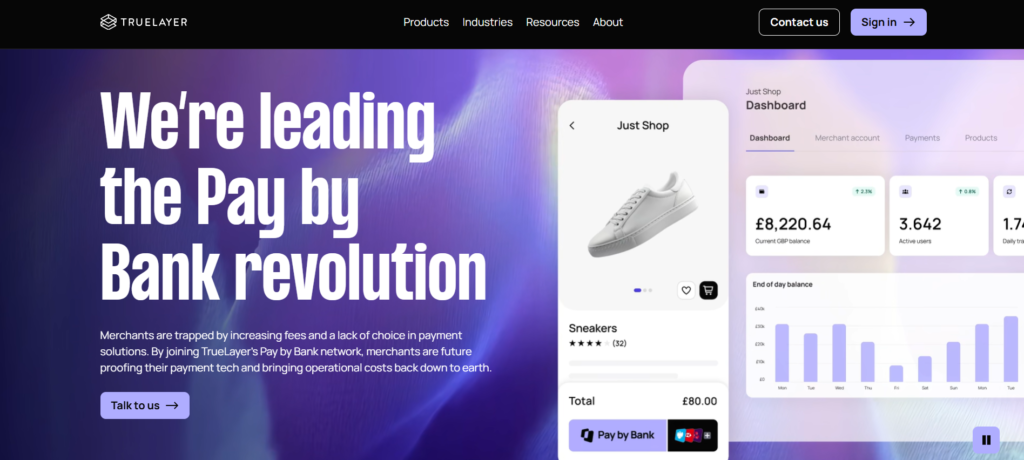
TrueLayer helps businesses build instant bank payments, payouts, and financial data integrations through a single API platform, with a strategic focus on reducing friction in checkout flows and lowering per-transaction costs versus card networks.
Founded in 2016, the company operates almost half of all UK Pay by Bank payments with more than 2x the daily volume of nearest competitors — a scale advantage that translates into faster bank relationship updates and higher transaction success rates.
The platform supports eight core products spanning both data and payment rails: Pay by Bank payments, Payouts, Bank on File (stored credentials for repeat payments), Data API, Verification, User Incentives, Signup+, and Verified Payouts. The infrastructure is FCA-authorised for both AIS and PIS services.
Pros:
- Dominant UK market position with 20M+ user network;
- Single API covering payments, payouts, and recurring flows;
- Variable Recurring Payment (VRP) support for subscription businesses.
TrueLayer’s network effect — 1 million new users each month — creates a flywheel where more consumer adoption drives better bank integrations, which attracts more merchant adoption.
This positions the platform as the default choice for UK-first payment infrastructure, though businesses needing transparent SMB pricing may find the sales-driven model a friction point.
Finexer
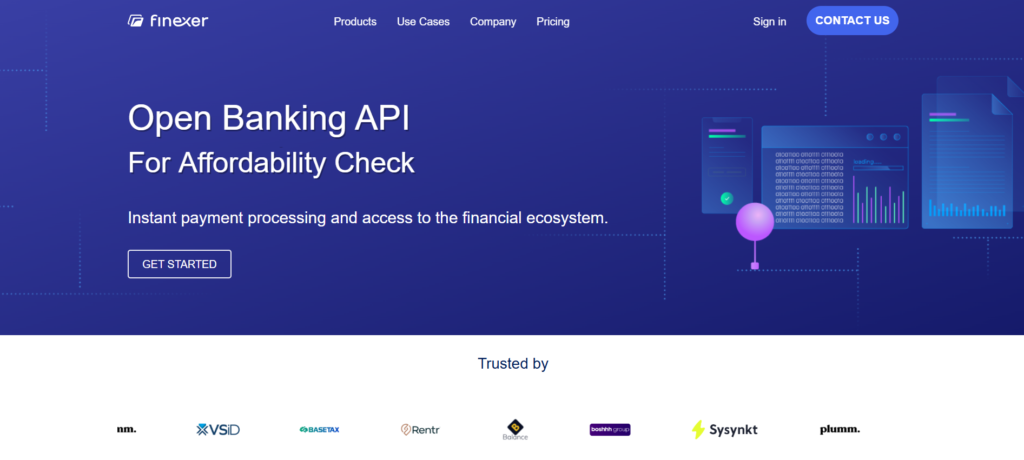
Finexer provides a unified API for real-time bank data access (AIS), Pay by Bank payments (PIS), and verification workflows, targeting businesses that want single-integration coverage across both data and payment use cases.
Founded in 2019, the platform focuses on the UK market depth rather than pan-European breadth, claiming 99% UK bank coverage with real-time, audit-ready financial data.
The platform’s core differentiation lies in B2B and Bank-to-Bank payments using IBAN or sort code/account number — a capability that matters for invoice settlement and supplier payment workflows where traditional card rails don’t fit.
Finexer also offers white-label customisation (custom HTML/CSS rendering) for businesses that need branded consent journeys without UI friction.
Core infrastructure capabilities:
| Feature | Implementation |
| Bank Transactional Data | Real-time AIS with audit trails |
| Instant Payments | PIS for single/batch transfers |
| Identity Verification | KYC workflow integration |
| A2A Payments | Account-to-account rails |
Pricing follows a three-tier model: Startup (discounted pricing for new businesses), Standard (standard pricing for established businesses), and Enterprise (volume-based pricing with account management).
All tiers include white-label capability and unlimited Finexer accounts. No setup fees, no hidden fees, no cancellation fees — a transparent structure that simplifies budget forecasting for early-stage platforms.
Volt
Volt builds the infrastructure that powers real-time account-to-account payments on a global scale. Since its founding in 2017, the company has connected thousands of banks and local payment schemes, creating a unified layer that removes most of the usual cross-border headaches.
Rather than forcing developers to learn every country’s instant payment rules, Volt abstracts the complexity (UK Faster Payments, SEPA Instant, US RTP, etc.) into a single, easy-to-use API. This lets merchants offer instant bank payments worldwide without the usual integration pain.
Key capabilities include:
- Instant Payments, Refunds, and fast Payouts;
- Volt Accounts with Virtual IBAN issuance;
- Payment verification and fraud protection tools.
The platform works especially well for ecommerce, crypto, iGaming, retail, and wealthtech companies. It’s also popular with businesses that want to reduce card network fees or need reliable cross-border instant flows.
Because Volt concentrates on real-time payment rails instead of data aggregation, it pairs naturally with AIS providers like Bud. Teams that need both enriched transaction data and instant settlement can comfortably use the two together.
GoCardless
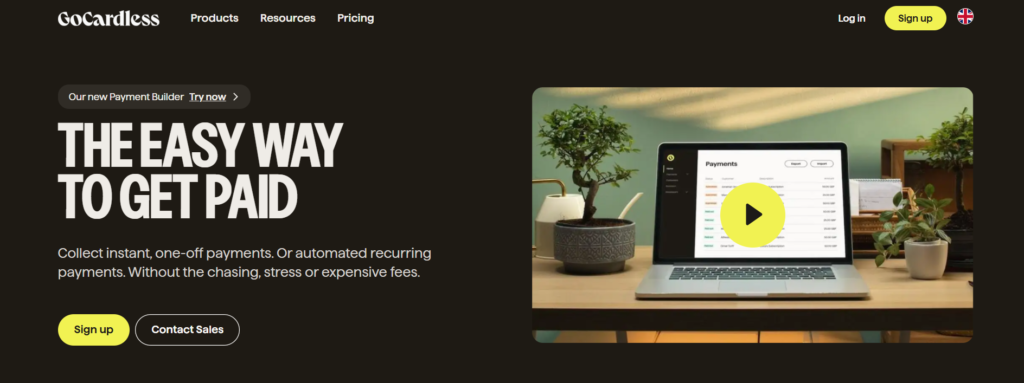
GoCardless is a global bank payment platform built specifically for collecting recurring and one-off payments directly from customer accounts. Founded back in 2011, it has grown by helping businesses move away from expensive card networks while keeping cash flow more reliable.
The platform’s real strength lies in automation. It handles the tricky parts of Direct Debit schemes across different countries and wraps them into simple, unified APIs. This means businesses can set up recurring collections in 30+ countries without dealing with each market’s unique rules.
Key strengths include:
- Smart retry systems that automatically chase failed payments.
- Full payment tracking and reconciliation tools.
- Over 350 ready-made integrations with popular software (Xero, QuickBooks, Salesforce, and more).
- Optimised workflows for subscription and recurring revenue models.
Unlike instant payment providers, GoCardless focuses squarely on Direct Debit. It’s authorised and regulated by the UK Financial Conduct Authority, which gives peace of mind to larger organisations.
You’ll find it most useful for businesses like SaaS companies, gyms, utilities, and membership organisations — anywhere that recurring payments and churn reduction are priorities over one-time checkout speed.
FAQ
Q: How much does it cost to integrate Open Banking APIs?
A: Pricing varies quite a bit. Some solutions have free starter tiers, especially for testing or lower volumes. For regular SMB use, expect to budget somewhere between £500 and £5,000 monthly. Bigger companies usually negotiate custom plans that grow with their transaction volume.
Q: Do I need my own PSD2 licence?
A: In most cases, no. You can build on top of a provider’s existing licence and regulatory permissions. This is how the majority of UK Open Banking projects work — it saves a lot of time and hassle.
Q: How long does integration usually take?
A: It depends on what you’re building. Simple integrations can be up and running in 2–8 weeks. More complex projects with custom authentication or extra compliance steps often take 8–12 weeks. Having good testing environments makes a noticeable difference in speed.
Q: What’s the difference between AIS and PIS?
A: AIS is all about viewing information — balances, transaction history, and account details. PIS actually moves money by initiating payments. Some providers combine both in one unified API, making life easier if you need the full picture.
Q: Which industries get the most value from Open Banking?
A: You’ll see strong results in e-commerce, crypto, iGaming, retail, and wealthtech. It’s also popular with lenders for risk assessment and with subscription businesses that want reliable recurring collections and lower churn.
Conclusion
The right Open Banking API provider depends on your specific use case. UK-focused platforms with transparent pricing reduce go-to-market friction for early-stage SaaS businesses.
Enterprises processing high payment volumes may prioritise network scale and uptime over pricing transparency. Pan-European products require multi-country bank coverage and regulatory flexibility under a provider’s licence. Recurring billing models suit Direct Debit infrastructure, while instant payments need real-time rails and 24/7 availability.
No single platform fits every need. Test sandbox environments with your own bank credentials, model transaction costs, and match provider capabilities against your geographic scope, payment requirements, and budget structure before committing.