
Getting clean, structured data into large language models is not as simple as it seems. Websites today are built with dynamic content, JavaScript-heavy frameworks, and anti‑bot protections.
For developers building RAG systems or fine‑tuning models, this creates a real problem. The goal is to turn messy HTML into something models can actually use.
The Real Bottleneck: Turning Unstructured DOM into LLM-Ready Format
Training an LLM or building a RAG pipeline requires data that is both clean and well‑structured. Raw HTML is not that. Why raw HTML fails:
- Navigation bars, ads, and scripts create noise that confuses models.
- Nested tables and inline styling break tokenization limits.
- Dynamic content loaded through JavaScript often does not appear in static source code.
Why plain text is not enough:
- It strips all context and hierarchy, such as headings and lists.
- Models trained on plain text struggle to understand document structure.
- Important semantic signals are lost, making retrieval less accurate.
This is where Markdown and JSON become essential. Markdown keeps the lightweight nature of plain text but preserves structure through headings, bullet points, and blockquotes. JSON delivers fully structured data ready for ingestion. The right web scraping API must output one or both of these formats directly.
The Solution: Evaluating Tools for Structured Output
Not all web scraping APIs handle structured output equally. Some return raw HTML and leave parsing to the user. Others offer built‑in extraction that delivers JSON or Markdown immediately. Three features separate a good API from a great one:
- Format flexibility – Can it output Markdown for RAG pipelines and JSON for training?
- AI‑based extraction – Does it adapt to layout changes without rewriting selectors?
- Integration depth – Does it work natively with LangChain, LlamaIndex, or other orchestration tools?
1. HasData
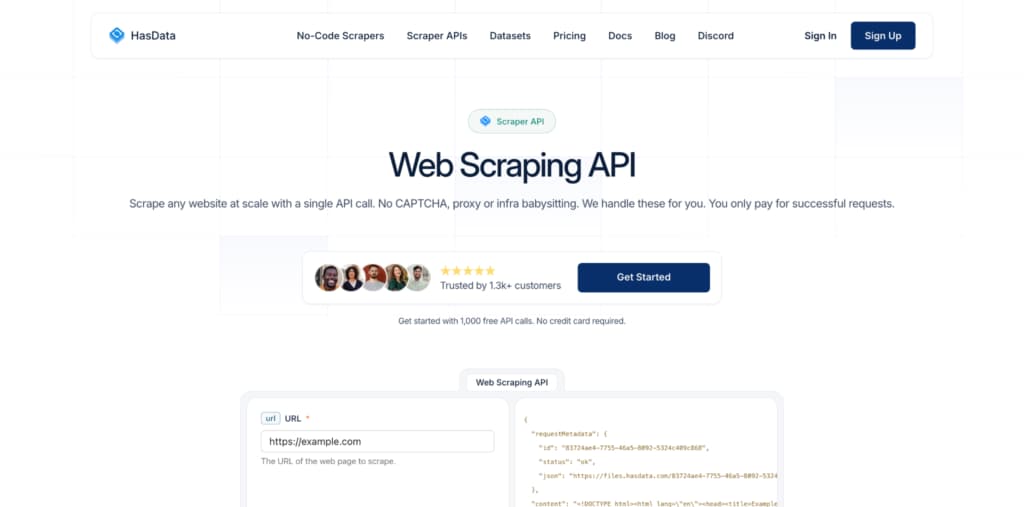
HasData, a Web Scraping API, is built for AI and LLM pipelines from the ground up. It delivers clean, model‑ready data in a single API call.
LLM-Ready Markdown Output
Send Markdown directly to a model or vector database. No cleaning. No extra parsing. This format keeps document hierarchy intact and removes noise automatically.
AI‑Based Extraction Rules
Define extraction rules through natural language or simple configuration. The system adapts when websites change, so there is no need to maintain custom CSS or XPath selectors across thousands of pages.
LangChain & LlamaIndex Integration
The API plugs directly into existing AI workflows. Whether building a RAG system or fine‑tuning a model, HasData fits without custom middleware.
Smart Auto‑Retry & Proxy Management
Failed requests retry automatically. A global pool of residential and datacenter proxies rotates behind the scenes to bypass geo‑blocks and anti‑bot systems.
Multi‑Format Output
Choose between full‑fidelity HTML, LLM‑ready Markdown, or lightweight plain text. This flexibility supports everything from archival to real‑time inference.
Anti‑Bot Evasion Without CAPTCHA Solvers
HasData bypasses CAPTCHAs using advanced evasion techniques. The system does not rely on solving challenges, which means faster responses and lower latency.
HasData is trusted by Copyleaks, Stanford University, and over 1,300 other customers. The infrastructure scales from thousands to millions of requests with 99.9% uptime. What makes HasData number one for AI pipelines?
- Single‑call simplicity – One API call returns Markdown or JSON ready for ingestion.
- No maintenance – Built‑in retries, proxies, and unblocking mean no infrastructure babysitting.
- Developer‑first support – Help comes directly from the engineering team.
2. Firecrawl
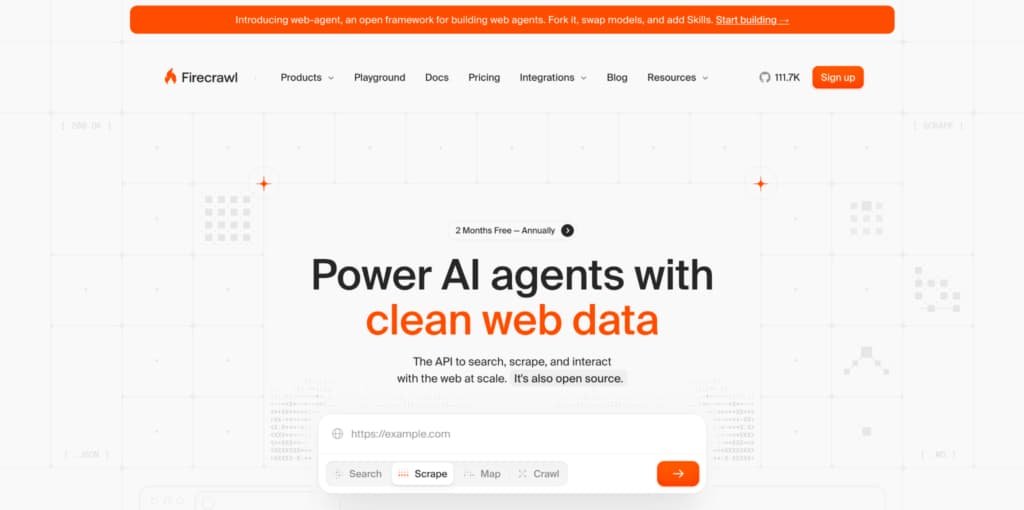
Firecrawl has built a strong reputation as a web data API designed specifically for LLM applications. Its core value proposition is turning entire websites into clean Markdown or structured JSON.
Markdown‑First Approach
Firecrawl converts web content into LLM‑ready Markdown by default. This format works well for RAG pipelines and knowledge base construction.
Custom Browser Stack
Version 2.5 introduced a custom browser stack that detects how each page renders. This allows extraction from JavaScript‑heavy applications, PDFs, and paginated tables.
Semantic Index
A built-in semantic index caches page snapshots, embeddings, and structural metadata. This feature serves 40% of API calls and improves both speed and coverage.
Search + Scrape in One Call
The /search API combines web search with scraping, returning results in Markdown, HTML, or JSON.
Considerations for AI Pipelines
Firecrawl delivers clean Markdown efficiently. The semantic index is a differentiator for repeated crawling tasks. However, the extraction approach remains largely rule‑based. For complex layouts that change frequently, teams may need to adjust selectors. Pricing and rate limits apply to higher volumes, and the self‑hosted option is still in development.
3. Zyte
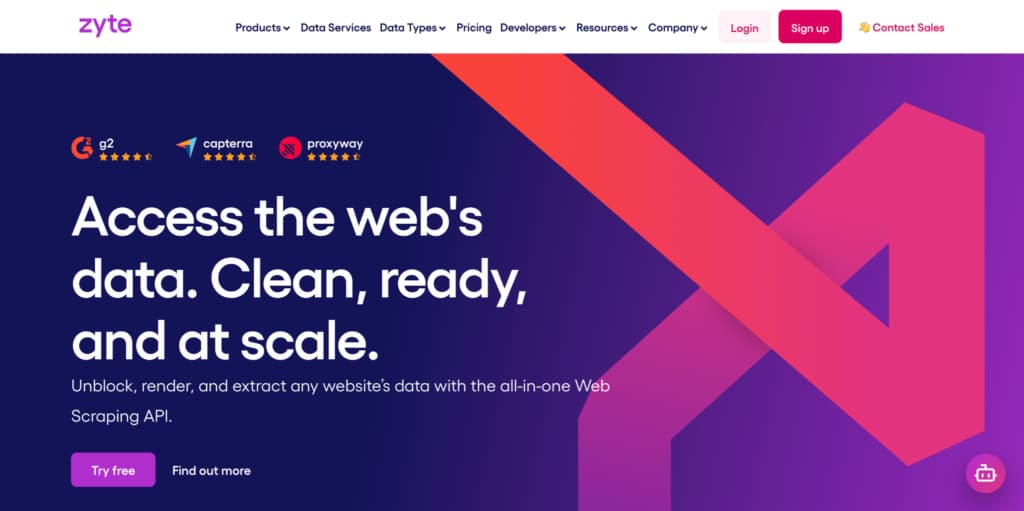
Zyte (formerly Scrapinghub) brings years of experience in web data extraction. The Zyte API now includes AI‑powered spider templates and a composite AI architecture.
AI‑Powered Spider Templates
Pre‑built templates extract data from e‑commerce sites, articles, job boards, and SERPs with zero setup.
Composite AI Architecture
The system blends custom Scrapy code, supervised ML for structured fields, and generative LLMs for reasoning‑intensive extraction. This hybrid approach balances cost, control, and flexibility.
Automatic Unblocking
Zyte handles bans, CAPTCHAs, and dynamic content. The API is designed for reliable, large‑scale crawling.
Structured LLM‑Friendly Schemas
Output follows predictable schemas, making integration with AI tools and agents straightforward.
Zyte offers a mature platform with strong unblocking capabilities. The composite AI architecture is sophisticated, but it also adds complexity. Teams need to understand when to use ML, LLMs, or custom code for each extraction task. Pricing is transaction‑based, and the full power of the platform may be overkill for simpler pipelines that only need Markdown output.
Which API Is Right for Your AI Pipeline?
Choose HasData if the goal is to get LLM‑ready Markdown or JSON in a single API call with minimal setup. HasData works well for teams building RAG pipelines, fine‑tuning models, or creating AI agents. The native LangChain and LlamaIndex integration saves development time.
Building AI models on web data requires clean, structured input. Raw HTML adds too much noise. Plain text loses too much context. Markdown and JSON are the right formats for the job.
HasData Web Scraping API delivers Markdown output, AI‑based extraction, and native LangChain integration in one package. The system handles proxies, retries, and unblocking automatically. Trusted by Copyleaks and Stanford University, HasData is built for teams that need reliable data at scale without infrastructure headaches.
Firecrawl offers a strong Markdown‑first approach with a custom browser stack. Zyte brings enterprise‑grade unblocking with composite AI. Each has its place. For most AI pipelines, the best choice is the one that removes the most friction: delivering clean, model‑ready data on the first call. That is exactly what HasData does.