
In the consumer goods industry, getting the product to the store is only part of the job. What happens on the shelf matters more: Is it in stock? Is it properly displayed? Are promotions clearly visible?
Many brands and distributors still have the same problem. Field teams often use one app to check planograms and a different system — or even pen and paper — to take orders. This split causes delays, errors, and lost sales.
As merchandising and selling become more connected, companies need software that combines both tasks. We explain the main features to look for in retail execution software and review strong solutions that handle both retail execution and field sales.
What to Look for in Retail Execution Software
Choosing the right retail execution software goes beyond basic features like photo capture and simple checklists. You need a system that turns regular store visits into useful data and actual sales opportunities.
Here are the most important capabilities to check:
Unified Workflow for Audits and Orders
The biggest issue with many tools is that audits and orders are handled separately. Look for software that lets the same field rep perform a shelf audit and place an order directly on the same mobile screen.
When these two functions are connected, reps can immediately act on out-of-stock items or planogram problems instead of losing that information in manual handoffs.
Strong Offline Functionality
Retail work often happens in places with weak or no internet connection. The software must work fully offline. Your team needs to take photos, record notes, and capture orders without a signal. Once they’re back online, everything should sync automatically, so no store visit is wasted.
Practical Photo Reporting and Planogram Compliance
The app should make it easy to take timestamped and geotagged photos. More importantly, managers should be able to compare these photos directly against the target planogram in the dashboard or app.
Features like image annotation and before-and-after views help identify and fix compliance issues quickly.
Route Planning and Visit Tracking
For teams doing direct store delivery or van sales, built-in route planning is very useful. The system should:
- Suggest optimal visit sequences based on location and time windows.
- Optimize routes to save travel time.
- Automatically track time between stops.
- Record the time spent in each store.
- Capture check-in/check-out data.
- Give clear visibility into team activity and performance.
Integration with Accounting and ERP Systems
Field data is only valuable if it moves smoothly into your other business systems. Look for software that connects directly with your accounting and inventory platforms. Orders taken in the field should automatically update stock levels and accounts receivable without manual re-entry.
This reduces errors and speeds up the whole process.
Flexible Pricing for SMBs
Many tools are built for large companies and come with long contracts and high minimums. If you’re a smaller or growing business, look for simple monthly pricing per user, no long-term commitments, and easy onboarding.
The best options let you adjust the number of users as your team changes without penalties.
Best Retail Execution and Field Sales Tools
Retail execution tools vary widely. Some focus only on shelf audits with no order capture, while others offer B2B portals without in-store mobility. The tools below were chosen for how they handle—or bridge—retail execution and field sales.
SimplyDepo
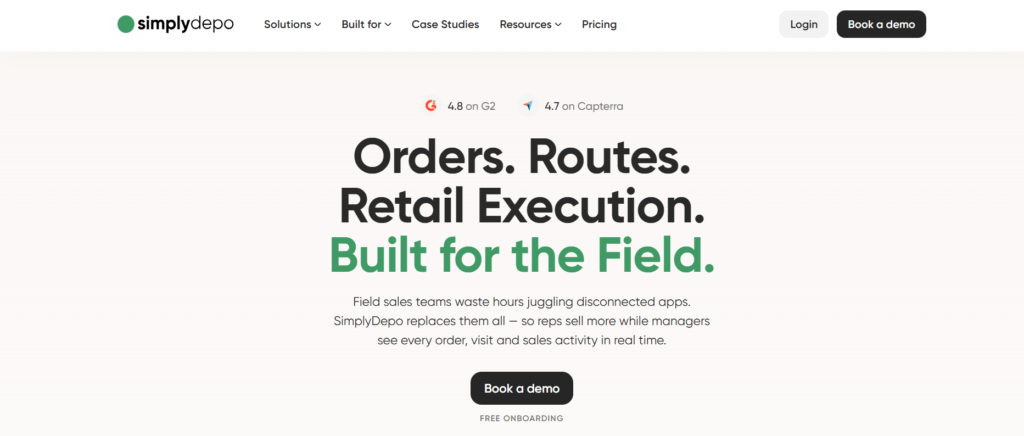
SimplyDepo is retail execution software built for CPG brands and distributors who need more than just shelf audits. It is a mobile-first platform that unifies retail execution and field sales into a single workflow.
While most audit tools stop at photo reporting and most sales apps stop at the order, SimplyDepo closes the loop entirely. The same representative who checks planogram compliance can capture a reorder, plan a route, complete a van sale, and sync results to accounting—all offline, all in one app.
Designed for SMB and mid-market teams of 1 to 100 reps, merchandisers, and route drivers across the US and Canada, SimplyDepo offers simple monthly billing at $89/rep/month with no annual contracts, no setup fees, and a 30-day free trial that includes free team training. Teams are typically up and running in days.
Main Capabilities:
- All-in-One Retail Execution: One mobile app for shelf audits, planogram checks, photos, order taking, route planning, and invoicing.
- Affordable Pricing for SMBs: $89 per rep per month with no contracts and a 30-day free trial.
- Works Offline: Records audits, orders, and invoices offline and syncs everything automatically once connected — great for areas with weak signal.
- Native QuickBooks & Shopify Sync: Orders and delivery data flow straight into QuickBooks and Shopify without any manual work.
- No More Audit-to-Order Delays: Fix shelf issues by placing orders right away.
- Smart Routing & Visit Tracking: Includes route planning, scheduling, and automatic visit tracking for DSD and van sales teams.
Who Should Still Choose SimplyDepo
SimplyDepo works really well for SMB and mid-market CPG brands and distributors in the US and Canada that depend on regular in-store visits.
It’s especially useful for teams that need to combine shelf audits, order taking, and delivery workflows into one simple system. Instead of jumping between separate audit apps, order apps, and spreadsheets, everything happens inside a single mobile workflow.
Best of all, you get this without the high costs or months-long implementation that usually come with enterprise tools.
Pros:
- All-in-one retail execution, field sales, and DSD workflow.
- Audit-to-order flow handled by the same rep.
- Simple pricing and fast setup.
- Offline-capable mobile app.
- Native QuickBooks and Shopify integration.
Cons:
- US and Canada only.
- Not built for global multi-region deployments.
- Not suited for compliance-only use cases.
- Requires active field or DSD operations.
Pepperi
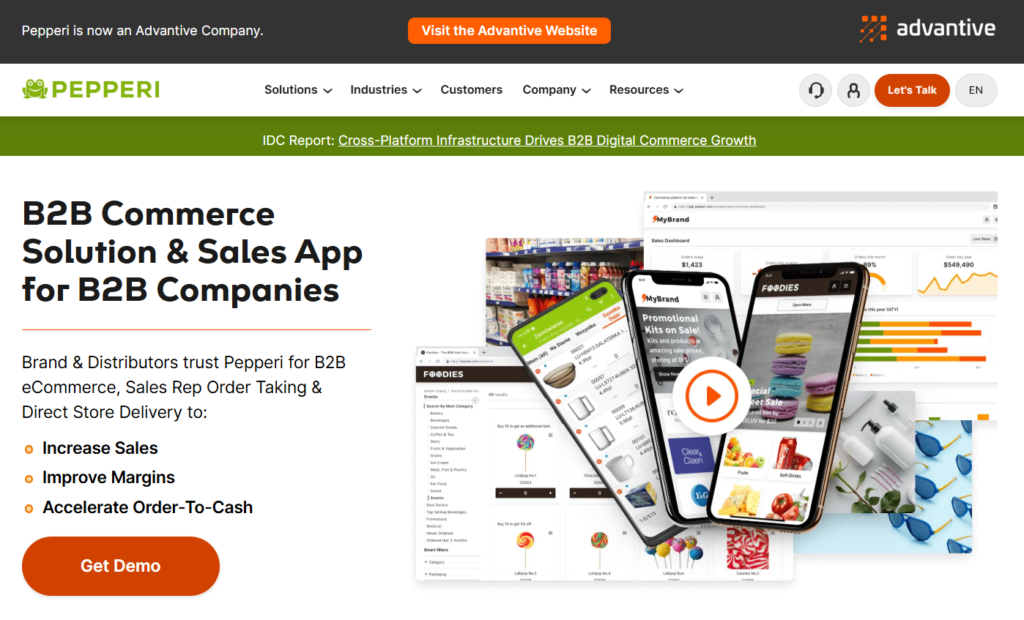
Pepperi is an enterprise-grade B2B platform that brings eCommerce, field sales, order management, retail execution, and direct store delivery together in a single system.
It’s built for mid-sized and large distributors with complex multi-channel needs — not really for small businesses.
The platform includes customer self-service portals, mobile apps for field teams, route accounting for DSD, plus modules for promotions, CRM, and inside sales.
Keep in mind that this level of functionality comes with higher costs (usually $500–1,500+ per month) and longer implementation times. It works best for companies that have the IT resources to handle it.
Main Capabilities:
- One unified platform: Brings together eCommerce, field sales, DSD, route accounting, CRM, and promotions.
- Self-service customer portals: Let customers check prices, browse catalogs, and place reorders online without calling.
- Mobile app for sales teams: Allows reps to capture orders, track merchandising, and handle daily visits in one place.
- Strong DSD functionality: Handles van sales, route planning, deliveries, and invoicing on the go.
- Easy Integrations: Connects directly with your ERP system and accounting software.
- End-to-end order-to-cash: Covers the full cycle from quoting to invoicing and receivables.
Who Should Still Choose Pepperi
If you’re a mid-market or enterprise distributor looking for a full B2B commerce ecosystem, Pepperi is worth considering. It’s especially useful for businesses with complex ERP systems, multi-region setups, or fairly complicated sales workflows.
The platform excels at handling the full order-to-cash lifecycle. However, be ready for a higher investment and longer implementation than with simpler alternatives.
Pros:
- Broad B2B commerce platform with eCommerce, field sales, and DSD.
- Includes route accounting and CRM features.
- Covers retail execution capabilities.
- Strong ERP integration support.
Cons:
- Higher cost compared to SMB-focused tools (Capterra reviews).
- Requires setup support or partner involvement (Capterra reviews).
- Customer support and billing issues reported by users (Capterra reviews).
Repsly
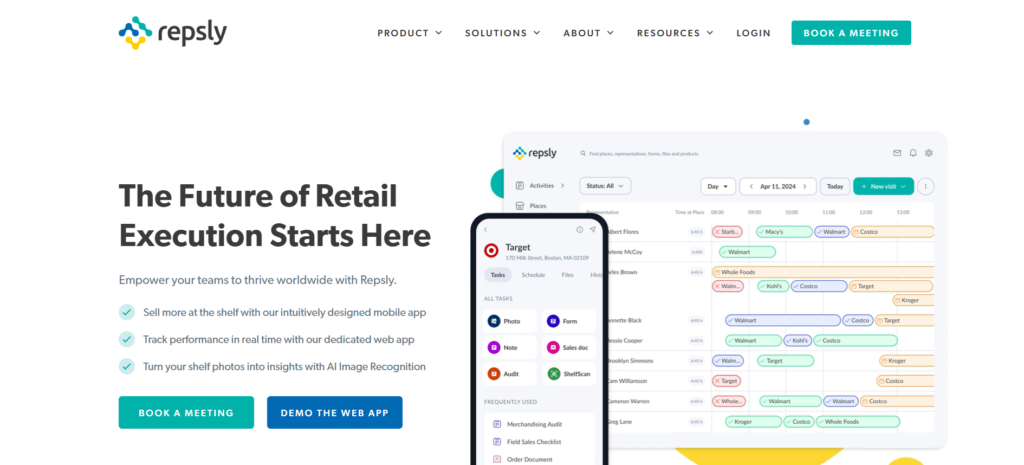
Repsly helps CPG brands and merchandising teams get a better picture of what’s happening on store shelves.
Instead of mixing auditing with order management, it concentrates on collecting structured data during store visits and turning that data into clear insights. Teams typically use it for shelf audits, planogram checks, tracking stock levels, watching competitors, and monitoring promotions.
A key highlight is ShelfScan AI. It automatically reads shelf photos to spot products and measure compliance, which means less manual work and better accuracy. The platform also provides field team tools like visit tracking, territory optimization, and real-time manager dashboards.
Repsly is not built for full order processing or DSD operations. It’s a good match for mid-sized to large CPG companies and retail service organizations that focus mainly on in-store visibility and audit quality.
Main Capabilities:
- Shelf Audits & Planogram Compliance: Structured tools to check product placement and adherence to planograms during every store visit.
- ShelfScan AI: AI analyzes shelf photos to detect products, measure compliance, and reduce manual work.
- Competitor & Promotion Tracking: Monitor competitor products, pricing, and in-store promotions in real time.
- Field Team Management: Visit tracking, territory planning, task assignment, and manager dashboards.
- On-Shelf Availability: Tracks out-of-stocks and inventory levels at each store.
- Standardized Merchandising: Tools to ensure consistent data collection across all teams and agencies.
Who Should Still Choose Repsly
Repsly is especially well-suited for mid-sized and enterprise CPG companies that focus heavily on retail execution visibility. Teams responsible for shelf audits, planogram compliance, and photo reporting will probably get the most value from it — particularly if they work with merchandising agencies.
It’s a good match when in-store accuracy and insights are more important than sales tools or direct store delivery (DSD) features.
Pros:
- Strong retail execution and merchandising focus.
- AI image recognition for shelf photos and compliance checks.
Cons:
- Back-office functions can feel clunky and poorly organized (G2 reviews).
- Occasional app logouts or stability issues (G2 reviews).
- Some usability issues in certain workflows (G2 reviews).
Zoey
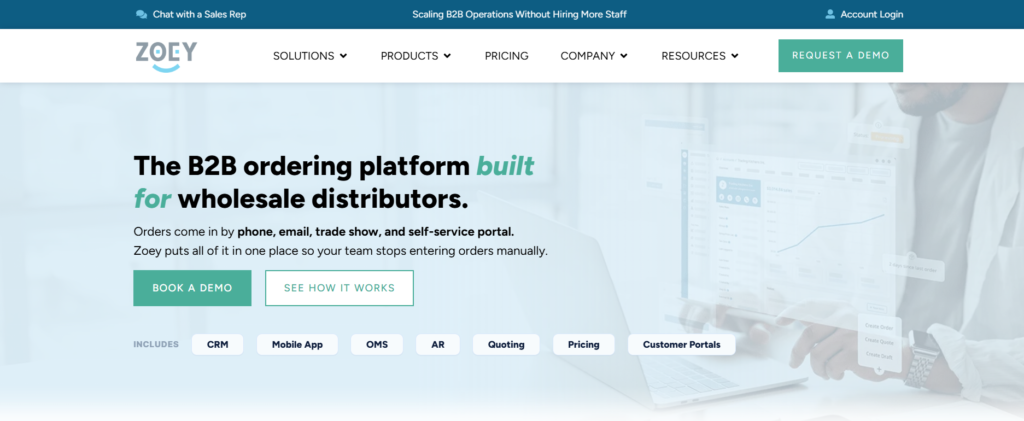
Zoey helps wholesale distributors, manufacturers, and B2B brands centralize orders from different sources. It focuses on online sales and back-office processes rather than on in-store activities.
It includes a branded customer portal that allows buyers to view pricing, reorder, and place orders themselves. Sales teams can create quotes and manage accounts via mobile or desktop.
The platform combines CRM, order management, invoicing, and accounts receivable automation, with solid integrations to NetSuite, QuickBooks, and ShipStation.
Note that Zoey does not support retail execution features like shelf audits or merchandising. It works best for wholesale companies looking to give customers self-service options while maintaining control over pricing and financial processes.
Main Capabilities:
- B2B Self-Service Portal: Branded portal for pricing, product browsing, and reorders.
- Order Management: Handles orders from portals, reps, phone, and email with automation.
- CRM & Account Management: Tools for managing accounts, quotes, and orders.
- Invoicing and AR Automation: Manages invoicing and accounts receivable processes.
- ERP Integrations: Integrates with NetSuite, QuickBooks, ShipStation, and more.
- Custom Pricing Control: Flexible customer-specific pricing and discount rules.
Who Should Still Choose Zoey
Zoey is a good choice for wholesale businesses that want to centralize order intake and enable customer self-service. Companies that rely on B2B eCommerce portals, quoting, invoicing, and account management will benefit from its functionality. It is particularly useful for teams that want to reduce manual order entry and improve back-office efficiency without focusing on field execution.
Pros:
- Strong B2B ordering portal.
- Built-in CRM and order management (OMS).
- AR automation and invoicing features.
- Customer self-service portals.
Cons:
- Slow or delayed customer support response times (Capterra reviews).
- Limited access to real-time support or direct assistance (Capterra reviews).
B2B Wave
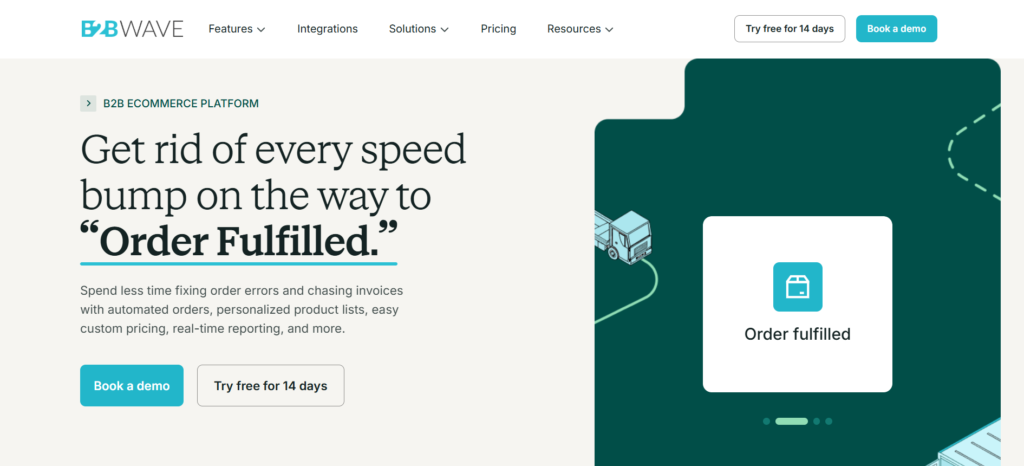
B2B Wave is a straightforward B2B eCommerce platform for wholesale distributors and manufacturers. It brings online ordering, customer management, and pricing together.
The platform focuses on simplifying wholesale orders rather than field sales or retail execution. Customers can use a branded online store to browse products, see their pricing, and place orders independently.
It includes catalogs, inventory tracking, custom pricing, order history, and solid reporting. It also integrates easily with QuickBooks, Xero, Stripe, and ShipStation.
This makes B2B Wave especially suitable for small and mid-sized wholesalers that rely on online ordering and want a simple solution without complex setup.
Main Capabilities:
- Branded Online Storefront: Customizable B2B storefront for customers to browse products, see personalized pricing, and place orders.
- Personalized Pricing and Catalogs: Allows custom pricing, discounts, and tailored catalogs per customer.
- Order Management & Reporting: A single place to manage orders with clear dashboards for sales and customer activity.
- Self-Service Ordering: Lets customers reorder, track deliveries, and manage accounts without calling a rep.
- Integrations: Native support for QuickBooks, Xero, Stripe, and ShipStation.
Who Should Still Choose B2B Wave
If you’re a small or mid-sized wholesaler and you’re after a simple, easy-to-use B2B eCommerce solution, B2B Wave is worth a look. Teams that focus on online ordering, flexible pricing, and customer self-service portals tend to get a lot out of it.
It’s particularly suitable when most of your business runs through digital channels, and you don’t need features for field sales, in-store audits, or direct store delivery.
Pros:
- Easy-to-use B2B eCommerce platform.
- Branded storefront support.
- Custom pricing capabilities.
- Order management features.
- Wholesale customer portals.
Cons:
- Limited reporting and analytics (G2 reviews).
- Integration limitations with external systems (G2 reviews).
Conclusion
Retail has changed. Monitoring shelves is no longer enough — brands must act immediately when problems arise.
The old separation between audits and field sales doesn’t cut it anymore. Choose a solution that brings route planning, audits, orders, and accounting together in one offline mobile app.
Smaller CPG brands often go for simple, affordable tools. Larger ones usually need stronger eCommerce and ERP capabilities.
Ultimately, it’s about equipping your reps to turn every store visit into actual sales.