
Most enterprise security problems do not start with hackers breaking through firewalls dramatically in the middle of the night. They usually start with access.
Someone has permissions they should not still have. A contractor account remains active long after a project ends. Privileged access quietly expands across departments because nobody wants to slow operations down by removing unnecessary permissions. An administrator accumulates access rights over several years until nobody fully understands what systems they can actually reach anymore.
This is the part of enterprise security that becomes difficult to manage at scale. Modern organizations operate across cloud environments, internal systems, remote work infrastructure, SaaS applications, vendors, contractors, and distributed administrative teams. Access governance becomes messy because permissions constantly evolve while infrastructure keeps changing underneath everything else.
That is why access governance moved much closer to the center of enterprise security strategy over the last several years.
The conversation is no longer only about authentication or password management. Organizations now care about visibility, policy enforcement, privilege control, behavioral monitoring, and understanding how identities move across environments over time.
Modern access governance platforms increasingly combine PAM, identity visibility, session intelligence, and governance controls into broader operational security ecosystems.
Here are seven enterprise security platforms organizations frequently evaluate when strengthening access governance across complex infrastructure environments.
1. One Identity
One Identity positions access governance as part of a much broader identity security strategy.
The platform focuses heavily on aligning privileged access management with enterprise-wide identity governance and policy enforcement initiatives.
Capabilities include:
- Privileged password management
- Session monitoring
- Access analytics
- Identity governance integrations
- Policy enforcement
- Secure access workflows
One Identity is commonly evaluated by enterprises already operating mature IAM programs, where governance visibility across identities, permissions, and administrative access needs to stay centralized.
The platform works especially well inside large hybrid environments where privileged access workflows intersect continuously with broader identity governance requirements.
Compared to more operationally focused PAM vendors, One Identity often feels more governance-oriented from the beginning.
2. Syteca
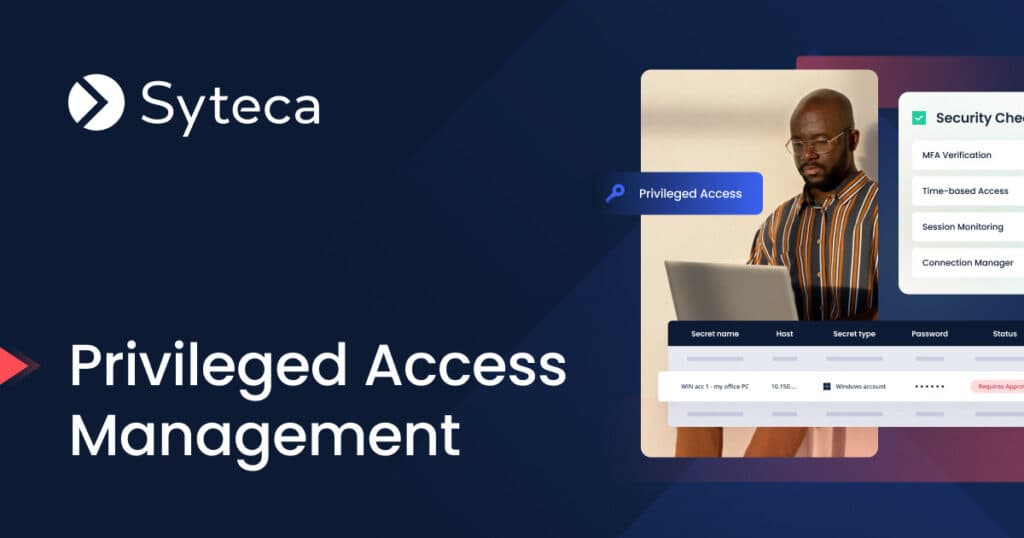
Syteca privileged access management approaches access governance through continuous visibility into privileged activity rather than relying only on static permission controls.
That distinction matters because modern access risks often develop gradually inside legitimate workflows.
A user may technically have approved access while still behaving abnormally during active sessions. Privileges expand over time. Contractors gain broader visibility than originally intended. Administrative activity starts crossing into unusual systems or environments without triggering obvious alerts.
Syteca addresses these situations through integrated PAM and identity threat detection capabilities built directly into the platform architecture.
Core functionality includes:
- Credential vaulting
- Privileged elevation management
- Just-in-time access provisioning
- Session recording
- Multi-factor authentication
- Secure vendor access workflows
- Real-time alerts
- Automated response actions
- Session blocking
- Continuous session validation
The platform focuses heavily on session intelligence and behavioral visibility across cloud, hybrid, and on-premises infrastructure.
That operational visibility becomes especially valuable for organizations trying to improve governance around privileged activity without relying entirely on manual auditing and static policy reviews.
Another major advantage is deployment flexibility. Many enterprises already operate fragmented environments where infrastructure spans internal systems, cloud workloads, remote administrative workflows, and third-party access simultaneously. Syteca supports those environments without forcing major infrastructure redesigns before governance controls become operational.
3. CyberArk
CyberArk remains deeply associated with enterprise-scale identity and privileged access security.
The platform combines PAM functionality with broader identity security and governance capabilities designed for highly segmented enterprise environments.
Core functionality includes:
- Credential vaulting
- Privileged session management
- Endpoint privilege controls
- Secure remote access
- Secrets management
- Identity security integrations
CyberArk is frequently evaluated by organizations managing highly complex infrastructure with mature governance and compliance requirements.
Its ecosystem depth makes the platform especially relevant for enterprises trying to centralize privileged access governance across large distributed environments.
At the same time, operational complexity and long-term administration requirements can become considerations depending on organizational scale and internal resources.
4. Delinea
Delinea focuses strongly on balancing privileged access governance with operational usability.
A lot of governance initiatives become difficult because security controls introduce so much administrative friction that teams eventually bypass them entirely.
Delinea attempts to reduce that problem.
The platform combines governance functionality with relatively manageable administration and deployment workflows.
Capabilities include:
- Credential vaulting
- Session management
- Behavioral analytics
- Least privilege controls
- Access governance
- Application access security
Compared to older enterprise PAM ecosystems, Delinea often feels lighter operationally while still supporting strong governance visibility across hybrid infrastructure.
That balance appeals strongly to organizations trying to modernize governance workflows without building oversized security administration environments around the platform itself.
5. BeyondTrust
BeyondTrust approaches access governance primarily through privilege reduction and operational visibility.
The platform focuses heavily on minimizing unnecessary access exposure across distributed enterprise environments while improving oversight into privileged activity.
Capabilities include:
- Privileged remote access
- Endpoint privilege management
- Session monitoring
- Credential management
- Vendor access security
- Least privilege enforcement
BeyondTrust became especially relevant as organizations expanded remote administrative access across hybrid work environments and cloud infrastructure.
A lot of enterprises realized that governance becomes much harder once privileges spread across remote systems, contractors, vendors, and distributed endpoints simultaneously.
BeyondTrust addresses this by tightening privilege exposure while improving centralized visibility into administrative activity.
6. WALLIX
WALLIX focuses strongly on governance visibility and privileged session oversight.
The platform is frequently evaluated by organizations operating in regulated environments where access traceability and audit visibility carry major operational importance.
Core functionality includes:
- Privileged account management
- Session recording
- Secure remote access
- Access governance
- Credential protection
- Compliance reporting
WALLIX often feels more concentrated around governance transparency itself rather than broad enterprise ecosystem expansion.
That focus appeals strongly to organizations trying to strengthen operational oversight around privileged sessions, contractor access, and distributed administrative activity.
Its detailed session visibility also supports enterprises operating under strict compliance and auditing requirements.
7. Securden

Securden focuses on centralized access governance without introducing excessive operational complexity.
Some enterprises want stronger governance visibility but prefer avoiding infrastructure-heavy deployments requiring extensive long-term administration.
Securden positions itself well for those situations.
Capabilities include:
- Password vaulting
- Endpoint privilege management
- Session monitoring
- Secure remote access
- Access approval workflows
- Audit visibility
The platform is frequently evaluated by organizations modernizing privileged access governance while trying to maintain manageable operational overhead across security teams.
Its administrative simplicity appeals particularly well to enterprises balancing governance improvements against limited internal staffing resources.
Access governance became much harder once the infrastructure fragmented
Several years ago, governance models were easier to maintain because infrastructure itself behaved more predictably. Most privileged access happened inside centralized environments where permissions stayed relatively stable over time.
Modern enterprise infrastructure looks completely different. Cloud systems expand constantly. Contractors move between projects. Remote access workflows evolve continuously. Administrative privileges spread across distributed systems and hybrid environments much faster than manual governance reviews can realistically keep up with.
That fragmentation exposed weaknesses in older governance models built around static permissions and periodic audits alone.
Organizations increasingly need continuous visibility instead of occasional reviews.
Enterprises now care more about visibility than static permissions
One major shift in access governance strategy is the growing focus on behavior and operational visibility.
Static permissions alone no longer provide enough context inside modern infrastructure environments.
Organizations increasingly care about:
- Session visibility
- Behavioral anomalies
- Privilege escalation activity
- Access approval workflows
- Continuous validation
- Real-time response capabilities
The strongest governance platforms now combine these capabilities into centralized operational environments rather than treating governance as a disconnected compliance exercise.
Governance platforms are becoming operational security platforms
Access governance is no longer simply about documenting permissions for compliance reports. Modern enterprises increasingly treat governance as a continuous operational security function tied directly to identity visibility, privileged behavior monitoring, and access risk reduction.
That shift explains why PAM, identity security, and governance platforms continue moving closer together technologically.
Syteca stands out especially well in this area because the platform combines privileged access management, session intelligence, and integrated identity threat detection capabilities inside unified governance workflows.
For many organizations today, access governance is no longer just about controlling who has access.
It is about understanding how that access behaves once people start using it.