
Every year, payment failures drain $118 billion from financial institutions. Despite that, plenty of CIOs continue working with vendors who have little to no hands-on PCI-DSS audit experience.
If you’re evaluating partners right now, you’ve probably noticed the gap. Many promise FinTech expertise but simply repackage generic solutions with a banking look. What actually separates the real specialists is their regulatory knowledge, payment systems experience, and ability to deliver software that passes tough FDIC reviews.
That’s why we put together this guide. It highlights five firms with genuine depth in financial technology. We evaluated them on practical criteria: years of building actual payment platforms, compliance support across PCI-DSS, SEPA, and KYC/AML, plus real specialization in core banking or transaction processing.
Each one brings something different to the table. Quick breakdown below:
| Firm | Best For | Founded | Notable Specialty | Service Model |
| Softjourn | Payment processing & prepaid platforms | 2001 | PCI-DSS compliant gateways | Full-cycle development |
| Itransition | ERP systems | 1998 | Microsoft Partner since 2008 | Enterprise solutions |
| N-iX | AI-augmented testing | 2002 | Legacy modernization | Co-implementation model |
| ScienceSoft | Software development | 1989 | Architecture Center of Excellence | End-to-end IT services |
| Geniusee | Custom software development | 2017 | Web development | Rapid MVP delivery |
What Financial Software Development Entails
At its core, financial software development means building secure systems for payments, core banking, compliance, and high-stakes transaction processing. These platforms handle real money under heavy regulation, so they need to meet PCI-DSS standards, support KYC/AML workflows, and maintain full audit trails for bodies like the FDIC and SEPA.
CTOs at banks, payment companies, FinTechs, and treasury departments look for partners fluent in Visa/Mastercard protocols, FedNow, SWIFT, and other key frameworks.
Unlike regular software, you can’t rely on generic SaaS here. Strict rules, legacy integration, and high volumes demand custom work. A recent 2026 survey found that 68% of financial CTOs point to vendors’ regulatory knowledge gaps as the main reason projects fail. That’s exactly why we focused on firms with proven, specific FinTech delivery experience.
How to Choose the Right Financial Software Development Partner
Picking a financial software partner isn’t easy. Focus on these practical points:
- Longevity and compliance memory — Companies around since 2001 have lived through many regulatory changes and bring valuable experience.
- Real payment expertise — Check for hands-on work with PCI-DSS platforms, card systems, and FedNow rather than generic API claims.
- Native compliance tools — KYC/AML, sanctions screening, and fraud detection should be built in from the start.
- Modernization strength — AI-driven testing and DevOps make a big difference when updating old core systems.
- Service approach — Understand exactly what you’re getting: full project ownership, collaboration, or just extra developers.
- Global reach — For international products, confirm they truly know SEPA, FedNow, and Interac through actual multi-country operations.
Leading Financial Software Development Companies for Enterprises
When enterprises seek financial software development partners, five firms consistently appear in procurement conversations. Below is a comparative overview of each.
1. Softjourn — Payment Processing & Prepaid Platform Specialist
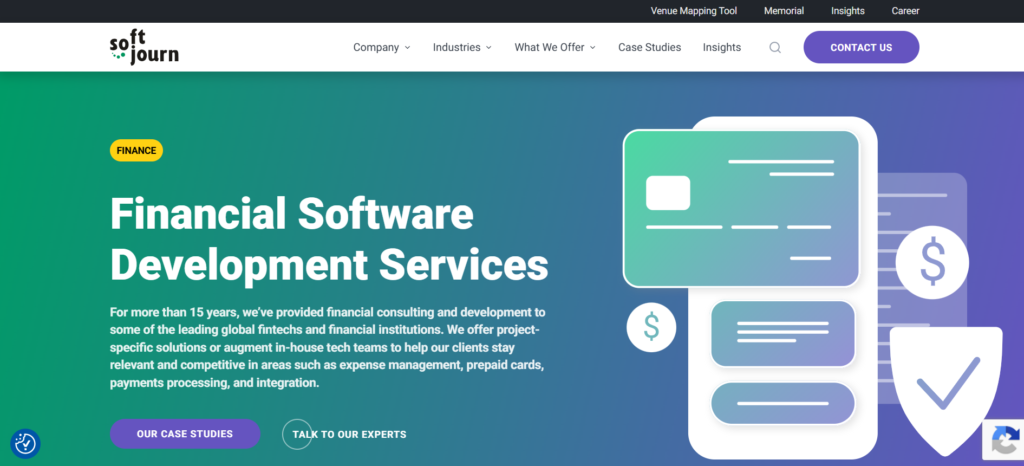
Softjourn is a full-cycle software consulting and development company with deep expertise in financial software development, operating since 2001 with a dedicated R&D practice supporting FinTech innovation since 2008.
Softjourn has delivered 150+ FinTech projects spanning payment processing and gateway development, prepaid, gift card, and corporate card platforms, and core banking system development.
The firm’s positioning emphasizes industry knowledge to build software that meets current needs and supports growth. Thirty published case studies cover PEX, PaySign, Viamericas, Versapay, and Tribal Credit — clients operating under PCI-DSS, FDIC, and payment network oversight.
FinTech integrations include Mulesoft, Salesforce, banking APIs, and KYC/AML/OFAC/CIP compliance tooling, signaling hands-on regulatory implementation experience rather than just API wrapper work.
The firm’s R&D practice, operational since 2008, focuses on AI-driven automation, fraud detection, and data platforms — relevant for clients modernizing legacy transaction systems without full rewrites. Client roster includes SVB (Silicon Valley Bank), CyberSource (Visa subsidiary), and Vanco Payments, all of whom operate under stringent regulatory frameworks.
What sets Softjourn apart:
- PCI-DSS compliant payment gateway development with documented integrations to Stripe, Apple Pay, Interac, First Data, and Worldpay.
- Card issuing and loyalty platform engineering for prepaid and corporate card programs.
- Buy Now Pay Later and installment payment development.
- R&D practice operational since 2008, focusing on fraud detection and AI-driven automation.
- Multi-year IAOP Global Outsourcing 100 listing since 2016.
Limitation: The company highlights a broad range of financial software services, but the website provides limited public information about pricing models.
2. Itransition — Enterprise ERP & Digital Transformation

Global software engineering company with 25+ years of experience, employing 3,000+ developers across 40 countries and holding Microsoft Partner status since 2008.
Itransition delivers enterprise-grade solutions with proven expertise in ERP, CRM, and digital transformation. The firm’s service catalog includes ERP systems, CRM implementation, and Dynamics 365 solutions, positioning it for financial institutions modernizing back-office operations rather than building customer-facing payment products.
Documented integrations include Microsoft Dynamics 365, Salesforce, SAP Commerce, AWS, and Atlassian — all enterprise stack components.
| Attribute | Value |
| Team size | 3,000+ developers |
| Founded | 1998 |
| Geographic reach | 40 countries |
| Primary focus | Digital transformation |
The firm’s Microsoft Partner status (held since 2008) signals deep integration capability with Dynamics 365 Finance & Operations, relevant for banks and financial services firms standardizing on Microsoft’s enterprise stack.
Limitation: No documented payment processing, PCI-DSS compliance support, or core banking project examples in the profile — the service catalog skews toward ERP/CRM modernization, which serves financial back-office needs but not transaction platform builds.
3. N-iX — AI-Augmented DevOps & Legacy Modernization

N-iX focuses on pragmatic AI engineering that integrates tools directly into your software delivery process. They co-implement the solutions with your team and then hand over full ownership, so you stay in control long after the project ends. This independence is a real advantage for banks careful about vendor lock-in.
The company offers AI-enhanced testing and QA, automated DevOps and CI/CD, plus faster legacy system modernization – particularly useful for COBOL-based banking cores.
Founded in 2002 with over 2,400 specialists, N-iX has applied AI internally and achieved up to 40% productivity gains. All work stays in private environments to protect your code and IP. They’ve delivered 50+ AI projects and have more than 100 certified AI developers on the team.
What N-iX brings:
- AI-driven automated test case generation for legacy modernization projects.
- CI/CD pipeline optimization, reducing deployment cycle time.
- Private cloud AI deployment ensuring client code never touches third-party servers.
- Knowledge transfer model preventing post-engagement operational dependency.
- 50+ delivered AI projects with documented implementation track record.
Limitation: The profile emphasizes AI/DevOps tooling but lacks documented payment processing or core banking case studies — the positioning serves legacy modernization needs rather than greenfield FinTech platform builds.
4. ScienceSoft — Architecture Governance & 36-Year Track Record
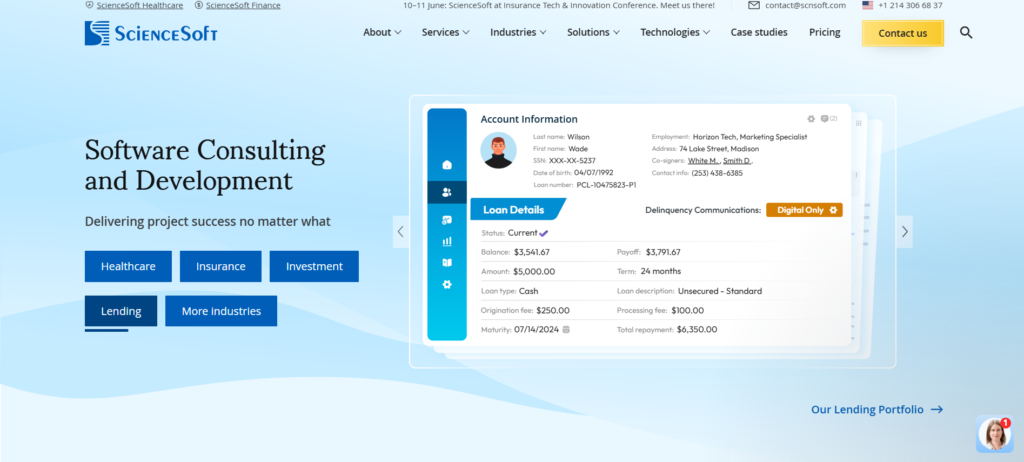
Software consulting and development company with 37 years of expertise, operating a dedicated Architecture and Solutions Center of Excellence staffed by nine principal architects with 15–25+ years of experience each.
ScienceSoft ensures every architectural decision is anchored in business impact through its Architecture Center of Excellence, a governance layer rare among mid-market vendors.
Founded in 1989, the firm employs 750+ IT professionals and offers software development, IT consulting, AI implementation, and help desk services — a full-stack service catalog suited for financial institutions standardizing on a single strategic vendor.
| Attribute | Value |
| Founded | 1989 |
| Team size | 750+ IT professionals |
| Architecture Center | Nine principal architects, 15–25+ years each |
| Service scope | End-to-end IT services |
The firm’s FAQ addresses common procurement concerns: trial service periods available to evaluate workflows, substantial transition periods in contracts to exclude sudden support wind-ups, and 24/7 help desk services covering all time zones.
Limitation: While the firm’s 36-year history implies regulatory compliance experience, the profile lacks FinTech-specific case studies or documented payment platform work — the positioning emphasizes architectural rigor and enterprise IT rather than niche financial software depth.
5. Geniusee — Rapid MVP Delivery & Transparent Sprints
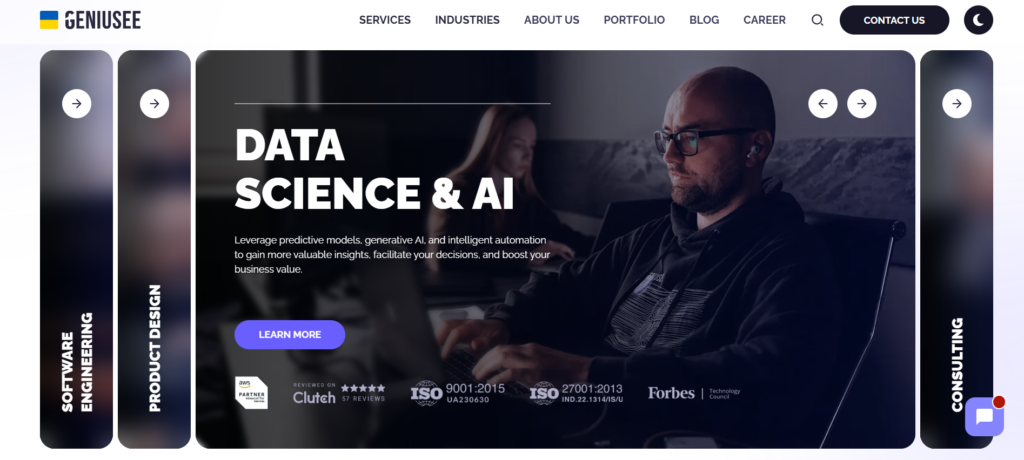
Custom software development company delivering full-cycle software and app development, founded in 2017 with expertise across 64 technologies and a focus on FinTech and EdTech verticals.
Geniusee connects business goals with rapid MVPs and cloud-native technical expertise, emphasizing transparent sprints, secure CI/CD, and AI-enabled test automation. The firm’s service catalog includes custom software development, AI software development, web development, and mobile app development — a stack suited for FinTech startups building customer-facing products under tight timelines.
The firm’s FAQ reveals 2–4 week dedicated team assembly timelines, 220+ specialists including AI experts, designers, QA engineers, and DevOps professionals, and full IP and documentation included with transparent sprints and clear accountability. LLM development keeps training data in client environments with no third-party model access — addressing data sovereignty concerns for regulated financial institutions.
Geniusee’s strengths:
- 2–4 week team onboarding supports rapid project kickoffs.
- AI software development, including machine learning models, NLP systems, and generative AI applications.
- Transparent sprints with secure CI/CD and AI-enabled test automation.
- AWS, Microsoft Azure, Google Cloud AI integrations.
- Private LLM deployment ensuring training data never leaves client infrastructure.
Limitation: Founded in 2017, making Geniusee the youngest firm in this ranking — the seven-year operational history limits institutional regulatory compliance depth compared to firms operating since the 1990s or early 2000s.
Frequently Asked Questions
Q: How much does financial software development cost?
A: Expect $80K+ for a basic PCI-DSS payment gateway MVP and $500K+ for full core banking projects. Hourly rates run $50–$150. Always get a clear SOW to avoid vague contracts that cause overruns.
Q: How long to build a PCI-DSS compliant payment gateway?
A: Most MVPs take 4–6 months, including audit preparation. Good AI testing and DevOps can shorten QA by up to 40%.
Q: What compliance support should a vendor provide?
A: Look for hands-on experience with KYC/AML, OFAC, and real audit support — not just promises. Ask for actual case studies.
Q: How can I check a vendor’s FinTech depth?
A: Review specific case studies on payment platforms or card systems. Generic “banking” claims are a red flag. Real experts often publish in FinTech media.
Q: Older vendor or modern tech stack?
A: Older firms offer strong regulatory memory. Newer ones bring fresh cloud and AI skills. Choose based on whether your project is greenfield or legacy modernization.
Conclusion
We evaluated firms based on documented FinTech experience, technical specialization in payments and core banking, and operational history for regulatory knowledge.
Sources included case studies, service catalogs, and verified integrations. Companies without specific PCI-DSS, KYC/AML, or payment platform proof were excluded. No marketing claims — only verifiable facts.
These firms offer distinct capabilities. Match the partner to your needs: payment gateway projects, COBOL modernization, or broader digital transformations.
A short scoping call upfront is highly recommended to surface compliance gaps before any formal agreement.